2026-09-16 SUNSHINE Engineering Team
How to Pick a Portable Inflatable Tent
Portability trades against span and durability. Learn how to pick a portable inflatable tent for rapid response and small crews.
A portable inflatable tent is not simply a small shelter; it is a system property that shows up in four places at once: the packed volume that has to fit the vehicle, the weight class that has to fit the crew, the deployment time that has to fit the mission clock, and the repack discipline that has to fit the end of a long shift. Teams that buy on any single number, usually packed weight, discover the other three on their first real deployment. Picking well means defining what portability must deliver for a specific response pattern, then accepting the trade-offs consciously instead of discovering them in the field.
What Portability Actually Means
Treat portability as a budget with four accounts. Packed volume decides whether the tent rides in the response vehicle alongside the rest of the kit or needs its own transport; packed weight decides whether two responders can move it across rough ground to the actual point of need; deployment effort covers crew size, pump independence, and the time from roll to readiness; repack effort covers drying, folding, and inspection after use, where most portability is quietly won or lost. A credible portable inflatable tent specification answers all four, and a supplier who quotes only one is describing a different product than the one a team will carry.
The accounts trade against each other in design. Lighter fabrics and slimmer tubes pack smaller and carry easier but accept tighter wind and abrasion margins; larger low-pressure tubes inflate fast with simple equipment but consume vehicle volume. Knowing which account the mission actually funds, minutes at a casualty point versus kilograms on a mountain track versus cubic metres in a van, turns the specification into a decision tool that matches the response pattern instead of a marketing number.
Power independence belongs in the same budget. The most portable tent in the fleet still needs air, and the difference between a format that inflates with a manual or foot pump and one that demands a charged battery or mains supply decides where the shelter can actually stand: on a track with no vehicle access, at night after a power failure, or in the first hour of a flood when charging opportunities have already disappeared. Buyers should treat pump type, spare power, and the physical effort of manual inflation as part of the portability specification, because a shelter that cannot be inflated where it was carried has not been carried at all.
Where the Portable Class Wins
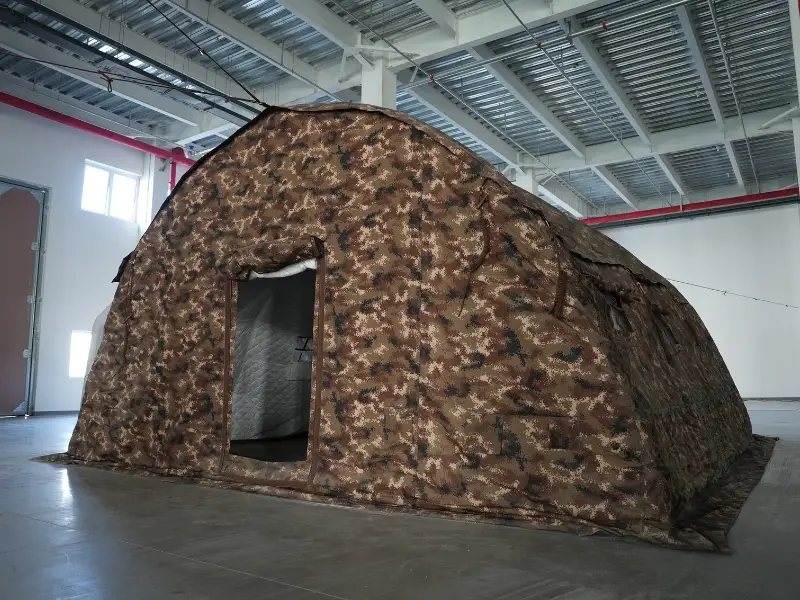
Rapid first response is the natural habitat. A shelter that a small team carries to the point of need and raises without power infrastructure serves casualty protection, triage cover, incident command, and survivor reception in the first hours of an event, and the logistic support tent shows the format in its working role.
The same logic scales across programs: the field shelter line grades from these carry formats up to large spans, so portable units work as the leading edge of a staged response that heavier structures follow.
Humanitarian practice values the same property. The UNHCR emergency shelter guidance frames shelter as a staged response instrument, and the portable class is what makes the earliest stages possible when access is damaged and vehicles are few. For planning, the Sphere Handbook names the covered-space and safety outcomes that any shelter, including a light inflatable one, exists to deliver, which gives evaluation teams language beyond setup speed.
Carry-Format Numbers From the Published Range
Portability claims resolve into published figures, and two formats from the SUNSHINE field catalogue carry the argument. The logistic support tent represents the protection end of the carry class, and the Z-fold modular unit represents the volume end, where floor space ships as a flat pack; both sit at the small extreme of the rapid deployment shelter spectrum.
| System | Specification | Published value |
|---|---|---|
| Logistic support tent | Puncture resistance | ≥ 1,000 N |
| Logistic support tent | Rated pressure | 0.2 MPa |
| Logistic support tent | Operating temperature | -43°C to +50°C |
| Logistic support tent | Storage temperature | -55°C to +70°C |
| Z-fold emergency response modular unit | Folded dimensions | 5900 x 2480 x 450 mm |
| Z-fold emergency response modular unit | Floor area | approx. 14.6 m² |
| Z-fold emergency response modular unit | Installation | 4-5 hours with 3-4 persons |
| Z-fold emergency response modular unit | Container loading | up to 10 units per 40HQ |
The two columns describe one budget from opposite ends. The tent line answers what the fabric and frame survive in the field, puncture class, rated pressure, and a -43°C to +50°C working window, while the module line answers what the mission can move, a 450 mm-thick folded block that opens into roughly 14.6 m² of floor. Agencies that stage responses the way the Global Shelter Cluster coordination toolkit organizes them buy both lines deliberately, kit for the first hours and volume for the first week.
The Trade-Offs You Accept
Span and duty come first. Portable formats cannot carry the clear spans or the anchorage of large tents, so programs route vehicle bays and ward-scale layouts to bigger systems and reserve the portable class for the missions it can honestly hold. Wind discipline follows: lighter structures demand stricter site selection, more conservative weather windows, and anchoring matched to the surface, and teams that respect those rules operate light tents safely across full seasons.
Durability is the quieter trade. Weight savings come from thinner materials and simpler fittings, which shifts the maintenance burden toward inspection cycles, patch readiness, and careful repacking between uses. None of this argues against the class; it argues for buying it with eyes open, budgeting the care the format needs, and resisting the temptation to treat a rapid-response tent as a permanent installation.
Storage conditions finish the trade picture. Portable packs live in vehicles, lockers, and depots where temperature swings and humidity work on fabrics between deployments, not during them, so the storage plan, dry before stow, off concrete, away from direct heat, inspected at set intervals, is part of the product cost. Programs in humid climates add ventilation checks to the interval, because the cheapest moment to find a storage problem is the scheduled inspection, and the most expensive is the callout.
A Pre-Purchase Portability Checklist
Run every candidate through six lines before the order, and put the answers in writing.
Folded footprint: demand the packed dimensions in millimetres and lay them against the actual vehicle bay, using the Z-fold unit’s 5900 x 2480 x 450 mm block as the reference scale for trailer-format kit. Crew and clock: the modular unit publishes 4-5 hours with 3-4 persons, and a candidate without a comparable line is quoting hope rather than a deployment figure.
Transport economics: the up-to-10-units-per-40HQ figure turns portability into procurement math, so ask for the container loading number before comparing unit prices. Protection class: the logistic support format publishes puncture resistance at the 1,000 N class and a rated pressure of 0.2 MPa, and a lighter carry format should still state its own numbers rather than the word reinforced.
Temperature windows: match the operating range, -43°C to +50°C on the published carry formats, and the storage range, -55°C to +70°C, against the depot climate the kit actually lives in. Escalation path: decide in advance which missions outgrow the carry class, because how to choose a large inflatable tent takes that question over, and what makes an airbeam tent different explains the tube mechanics underneath both sizes.
The checklist assumes the mission knows its own trigger. Teams that write activation criteria in plain terms, the pattern the IFRC disaster reference follows when it classifies what counts as a disaster, buy portability against a known event instead of a mood.
Running a Portable Tent Program
Institutionalize the carry kit. The tent, pump, anchorage set, repair patches, and instructions should live together as one checked item, because the failure mode of portable programs is the intact tent that deploys without its fittings, and a kit checklist maintained at reconstitution closes that gap. Training follows the same pattern: every crew rotation rehearses deployment and repack until both fit inside the mission clock, and the rehearsal doubles as the inspection.
Plan the lifecycle between deployments. Dry, inspect, fold to pattern, and store the kit where the next rotation can find it complete; log each use in the same file as the repair patches applied, and retire fabrics on evidence rather than on optimism. Programs that manage portable shelters this way keep them in the response fleet for years, and the emergency relief applications page shows the deployment contexts where that discipline earns its keep, from disaster first response to relief staging, with the wider equipment catalogue available when the mission outgrows the carry format.
FAQ
How small can a portable inflatable tent go?
Small two-person carry formats exist for casualty and equipment cover, while squad-size units still fit standard response vehicles. The right size follows the mission clock and the crew available to carry and raise it.
Are portable inflatable tents durable enough for real use?
Yes, within their class. Thinner materials trade durability for weight, so durability comes from inspection cycles, prompt repairs, and correct repacking rather than from the fabric alone.
Can one crew deploy a portable tent without vehicle support?
That is the design goal of the class: a small team, a pump, and an anchorage set sized for the surface. Rehearsal matters, because practiced crews keep deployment inside the response window.
When should a team choose a larger inflatable tent instead?
When the mission needs vehicle bays, ward-scale covered space, or longer installation periods, larger formats in the same product family carry those loads, and the portable unit becomes the leading edge instead of the whole answer.