2026-09-10 SUNSHINE Engineering Team
What Is FR Fabric and Why Ratings Matter
What is FR fabric? Learn how flame-retardant ratings, fiber type, and coating weight decide material choice for shelters and protective covers.

What is FR fabric? The two letters stand for flame retardant, and behind them sits a family of engineered textiles designed to slow ignition, limit flame spread, and reduce afterflame when the material meets fire. What is FR fabric in practice is a chain of choices: the base fiber, the retardant chemistry applied to it, and the coating that seals the system, each layer documented by ratings a buyer can verify. This guide unpacks those layers in order, explains how to read the rating names, and ends with a selection routine for shelter and protective-cover programs.
The Definition, Stated Precisely
FR fabric is fabric engineered to resist catching fire and to self-extinguish or burn slowly when the ignition source is removed. It is not the same as fireproof, which promises performance no textile delivers, and the distinction is the first thing a specification meeting should settle; the flame retardant overview covers the mechanisms, char formation, gas-phase interruption, and cooling, that make the claim testable.
The claim is always tied to a test. Standards also age, and editions matter in regulated sectors, so the document check includes the edition year; a fabric qualified against a retired edition may still serve, but the program should know it is carrying legacy evidence before an inspector points it out. A fabric earns its FR description by passing a specific standard under specific conditions, which means the honest answer to any FR question is a document: which standard, which method, and which passing result. Buyers who ask for the document instead of the adjective end up with materials that behave in the field the way they behaved in the lab.
How the Retardant Actually Works
Retardant chemistry interrupts combustion at a stage of the fire triangle. Some systems char: Char-forming systems suit shelter panels, where the insulating crust protects the weave long enough for evacuation margins, while gas-phase systems often serve interiors where spread control matters more than insulation; the mechanism on the sheet, when the supplier states it, hints at which failure scenario the fabric was engineered against. the fabric surface converts to a carbon layer that insulates the material beneath, and the burn starves itself; other systems release radicals that quench the gas-phase reactions of flame, or coatings that dilute fuel gases, and many modern textiles combine mechanisms in one finish.
The mechanism lives in the finish or the fiber. Inherently resistant fibers carry their behavior in the polymer itself and keep it through laundering and weathering, while finished fabrics gain resistance from a treatment applied to the cloth, durable through a rated number of cycles but conceptually a layer that can age. Specification sheets that name which of the two you are buying let a maintenance program plan around the difference instead of discovering it.
Reading Ratings Without Guessing
Rating names encode the test regime. Conditioning details deserve the same scrutiny as the threshold. A rating measured on fabric as delivered answers a different question than one measured after washing or weathering cycles, and shelters live outdoors, so the cycle information often matters more than the raw pass value; two fabrics with the same standard cited and different conditioning are simply not the same material.
Different markets maintain different standards families for textile flammability, vertical flame tests, spread-of-flame methods, and melt-drip behavior among the common axes, and a specification that cites a standard by name and edition lets any engineer look up the pass criteria; a sheet that cites nothing leaves the two letters doing work they cannot do alone.
Three questions decode any rating. What was tested, the fabric as delivered or after a conditioning cycle; what was measured, char length, afterflame time, ignition of an underlying layer; and against what threshold. A strong supplier answers with the test report, and programs in regulated sectors treat the report as part of the purchase order, because the rating ages with the fabric and the audit trail needs the baseline.
Verified Flammability Values Behind the Two Letters
The rating vocabulary lands harder with real sheet values underneath it. The table below collects factory-verified figures for six published constructions in the SUNSHINE functional materials range, warp and weft reported separately because weave direction is part of the tested system. Treat the rows as evidence of spread rather than a ranking; the construction a program needs depends on the duty it faces.
| Fabric | Weight (g/m²) | After-flame time, warp/weft (s) | Damage length, warp/weft (mm) |
|---|---|---|---|
| Flame-Retardant Oxford Fabric 150D | 140 | 5 / 5 | 10 / 10 |
| Flame-Retardant Anti-Static Polyester 600D/3×3 | 300 | 5 / 5 | 10 / 10 |
| High-Tenacity Flame-Retardant Polyester 500D | 310 | 10 / 10 | 12 / 12 |
| 1000D Polyester with PU Coating | 360 | 10 / 10 | 15 / 15 |
| 100% Cotton Flame-Retardant Canvas 12/4×4 | 400 | 6 / 6 | 15 / 15 |
| Polyester with PU Coating 500D/3×3 | 630 | 18 / 18 | 25 / 25 |
Fiber Choice Sets the Floor
Polyester is the workhorse of shelter and cover fabrics, Fiber blends appear at the edges of the category, with poly-cotton constructions trading some water behavior for handle and print surface; the blend question enters mostly in industrial covers, and the same reading routine applies once the sheet names the blend honestly.
and the polyester reference explains why: strength, dimensional stability, and affinity for coatings that field programs depend on. In FR form, polyester carries retardant finishes and coatings well, and the denier of the yarn sets the abrasion and strength floor independently of the fire behavior.
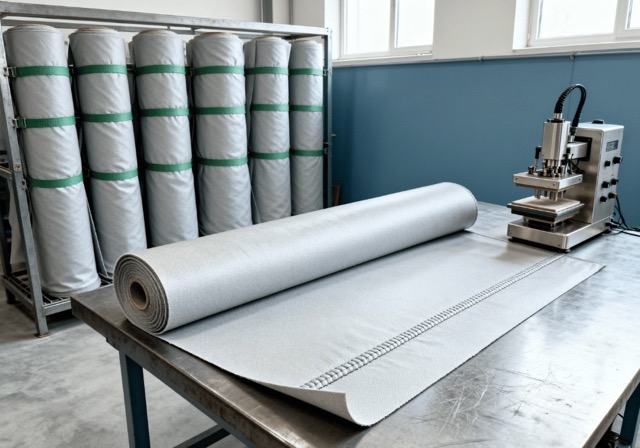
Denier and weight describe structure, not safety. A 500-denier high-tenacity FR polyester, such as the high-tenacity FR polyester 500D used for shelter panels, pairs its retardant system with a 310 g/m² coated weight, and heavier constructions like the 1000D PU coated polyester trade pack size for tear margin; the functional materials line spans this spectrum from 140 g/m² Oxford fabrics through 630 g/m² coated polyesters, with anti-static options for environments that add static to the fire question.
The Coating Completes the System
Coatings do structural and protective work at once. A PU coating bonds to the woven base, blocks water, and adds abrasion surface, and its weight contributes to the g/m² figure on the sheet; the coating can also carry or support the retardant behavior, which is why fire ratings apply to the finished composite rather than to the greige cloth.
That composite rule is the one buyers break most often. Substituting a base fabric with an equivalent denier but a different coating silently changes the tested system, and the rating no longer travels with the purchase; specification discipline means specifying the finished fabric, weight, construction, and coating together, as the product pages in the SUNSHINE materials catalog do when presenting each fabric as a complete, factory-verified system.
A Selection Routine That Survives Audits
Write the application sentence first: what the fabric covers, what ignition sources share its space, and what weathering cycle it must survive, then translate that sentence into three requirements, a verifiable FR rating named by standard, a structural weight and denier class for the mechanical loads, and a coating system matched to the exposure. The same routine scales from a single cover to a full shelter program, because the three lines travel with the requirement, not the product, and materials shortlisted for a panel build requalify cleanly when the program adds tents or covers later. any candidate that fills two is not a discount, it is a different product.
Ask every shortlisted supplier for the test report behind the FR line, the coating specification behind the weight, and the factory verification behind the construction. Suppliers who answer with documents ship fabrics that behave like their sheets, and programs that file those documents with the purchase order never have to explain a gap during an inspection.
When a shortlist survives that routine, the standard-by-standard comparison in flame retardant fabric types, tests, and selection maps the same ratings onto specific fabric families.
What the After-Flame and Damage Columns Mean for a Buyer
Damage length is the column that separates candidates: it runs from 10 mm on the 140 g/m² Oxford to 25 mm on the 630 g/m² high-strength polyester, so the heaviest roll in the sample also posts the longest damage length. After-flame time sits between 5 and 10 s on five of the six rows, with the 630 g/m² construction at 18 s, so neither column follows weight in a straight line; the retardant system does that work, and the two axes are specified on separate lines of the sheet. The same discipline extends across the whole specification, and the PU coated polyester fabric guide walks the mechanical fields one by one.
Which family delivers those numbers changes how they age: inherent fibers hold the behavior in the polymer, treated cloths carry a finish with service limits, and the inherently flame retardant vs treated comparison sets out that split. Market framing decides how the columns get indexed in the first place. European buyers arrive through the CE marking framework and the European standards portal, while Gulf procurement reads SASO technical regulations as its local rulebook, so the paper trail gets built for a destination as well as a duty.
How to Read the Test Report Behind the Rating
Reports answer questions in a fixed grammar: who tested, against which method and revision, with what specimen preparation and conditioning, on whose behalf, and with what result in the vocabulary of the standard. A report missing any of those elements is a page, not evidence, and the report chain is part of the product because the fabric and its paper travel together through audits, insurers, and the next engineer who inherits the installation.
Lot traceability closes the reading. A report on a representative sample says the construction can perform; a report tied to the delivered lot says this roll performs, and the difference matters precisely where the rating will one day be questioned. Ask how lot documentation connects to test evidence before the order, not after the incident, and treat suppliers who answer easily as suppliers who have done this before.
Compare candidates by procedure rather than brochure. Line fabrics up by standard, ignition variant, and conditioning, and the index grades become an ordering that means something. Where paperwork does not align, requesting the missing element is a legitimate part of procurement, and how a supplier responds tells you as much about the operation behind the fabric as the rating itself does. SUNSHINE keeps the matching paperwork with every certification record it publishes.
FAQ
Does FR mean the fabric cannot burn?
No. FR fabrics resist ignition and limit spread, and many self-extinguish after the flame source is removed, but no textile is fireproof in the everyday sense of the word.
Is the rating in the fiber or the finish?
Either. Inherently resistant fibers carry the behavior in the polymer, while finished fabrics gain it from a treatment that has a rated durability; the specification sheet should say which one you are buying.
Does a heavier fabric mean better fire performance?
Not by itself. Weight and denier set mechanical properties, while the retardant system and its test rating set fire behavior, so the two axes are specified separately and verified separately.
Can I substitute an equivalent denier fabric?
Not without requalifying the rating. Fire performance is tested on the finished composite of fiber, finish, and coating, so substitutions change the tested system even when the denier matches.