

Self-righting rescue craft
Inflatable Self-Righting Rescue Boat
Inflatable craft designed for flood, white-water and unpredictable river-rescue missions.
Customizable to specification
- Models
- IRB400 / IRB460
- Length
- 400 / 460 cm
- Engine power
- 60 hp
- Weight
- 130 / 150 kg
Overview
Built for extreme and unpredictable river, flood, and whitewater rescue missions, our Inflatable Self-Righting Rescue Boat offers operational stability and control.
Key Features
Automatic Self-Righting Capability ;
Reliable in Rough Conditions ;
High Performance ;
Crew Safety Priority ;
Operating environments for a self-righting hull
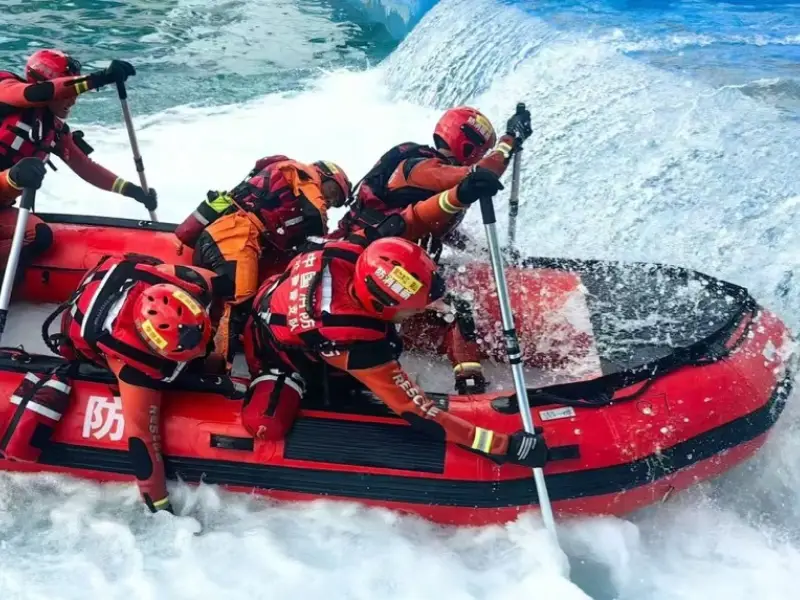
Whitewater sections are the design case. In gorges and rapids, stopper waves and hydraulics capsize conventional hulls, and a rescue boat that stays out of action after a knockdown loses the window the crew was launched into, so the automatic self-righting capability exists to return the hull to an operative attitude and let the mission continue. Discipline context sits in our swift water rescue equipment guide.
Flood channels during levee or embankment breaches form the second environment. Standing waves, debris, and reverse flow around structures create the conditions where hulls get rolled, and the 60 hp recommended engine gives the power reserve needed to punch upstream against current and hold a rescue position. Craft selection around these constraints is laid out in the flood boat walkthrough.
River patrol during spring runoff and dam releases rounds out the operating set, when volumes run far above seasonal norms. Agency context for flood-scale response sits with the IFRC disaster reference, and operational frameworks such as NFPA 1670 govern how organizations scope water rescue capability.
What the IRB400 and IRB460 numbers tell you
Both models carry the same 60 hp recommended engine, and that figure is the headline: it places the hull in the engine class used for working moving water rather than calm-surface patrol. The dimensional gap is modest on paper, with the IRB400 at 400 by 210 by 220 cm and 130 kg against the IRB460 at 460 by 235 by 240 cm and 150 kg, but it translates into more working length and beam for 20 kg of extra handling weight.
The tube figure rewards attention, since 60 cm of tube diameter against a 210 or 235 cm beam is a large volume fraction of the hull, and that displacement high in the section is what the self-righting behavior is built on. The published heights of 220 and 240 cm describe substantial topside structure that participates in the same righting geometry. What the sheet does not publish is a righting test figure or a person capacity, so both belong in the acceptance conversation with the supplier.
Buyer questions answered
Does it self-right with crew and equipment aboard?
Automatic self-righting capability is the stated design intent of the series. Behavior with a specific crew count, engine, and equipment load is a test question rather than a catalogue line, so it depends on the configuration, confirm with the engineering team.
Which model should we order?
The published differences are dimensional: the IRB460 adds 60 cm of length, 25 cm of beam, and 20 kg over the IRB400, with the same 60 hp recommendation on both. Transport and launch capacity usually decide this one, since the larger hull needs more vehicle and slipway. Person capacity is not published, so crew planning is another point to settle in writing.
Is 60 hp required?
The specification reads recommended engine power, 60 hp on both models, which is a design point rather than a limit. Rigging below it cuts reserve against current, and rigging above it enters territory the sheet does not rate. Between deployments, the inflatable rescue boat maintenance checklist covers the routine for both builds.
Specifications
| Product | Inflatable Self-Righting Rescue Boat |
|---|---|
| Specification | Self-righting rescue craft |
| Item No. | Length(cm) | Width(cm) | Height(cm) | Tube Diameter (cm) | Weight (kg) | Recommended Engine power (hp) |
|---|---|---|---|---|---|---|
| IRB400 | 400 | 210 | 220 | 60 | 130 kg | 60 |
| IRB460 | 460 | 235 | 240 | 60 | 150 kg | 60 |
Applications
Customization
All specifications — including dimensions, materials, coating, colour, and accessories — can be tailored to your project requirements. Flexible MOQ from prototype to full-scale production; standard custom projects take 15–30 days from design confirmation to sample delivery.
Water Rescue Systems — common questions
Related products

Drop-stitch rescue platform
Inflatable Rescue Pontoon
Stable inflatable pontoon for water-rescue access, temporary work platforms and casualty transfer.

Multi-model rescue boat
Professional Inflatable Rescue Boat
Configurable inflatable craft for professional water rescue and emergency-response operations.