2026-07-09 SUNSHINE Engineering Team
Inflatable Rescue Stretchers
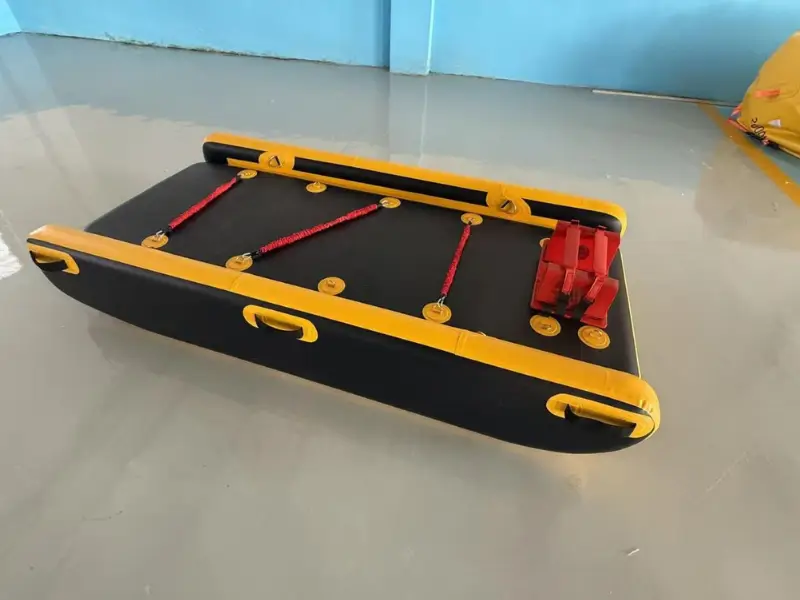
Inflatable floating stretchers for casualty support and transfer in water-rescue operations.
Use cases
- Water Rescue
- Ice Rescue
- Flood Response
- Mountain & River Rescue
- Emergency Patient Transport
Key Features
- High-strength drop stitch construction
- EVA anti-slip surface
- Fast inflation and easy storage
- Floating design for water rescue
- Reinforced handles and fixing points
- Lightweight, portable, and durable
- Custom sizes and colours available
Available Models
| Model | Size | Inflation Time | Handles | Safety Straps |
|---|---|---|---|---|
| IRS-230 | 227 × 115 x 15cm | ≤ 60 s | 6 | 4 |
| IFRS-210 | 210 × 80 × 15 cm | ≤ 40 s | 8 | 3 |
Field use cases for the IRS-230 and IFRS-210
Flood response is the lead use case. When a patient cannot walk out of a flooded block, the stretcher floats them over submerged obstacles to a boat or to dry ground, with the safety straps holding position during the move. The floating design is the working principle here rather than an accessory, because the 15 cm drop-stitch body is the buoyancy. Kit roles across a flood response are mapped in our water rescue gear guide, and the WHO drowning fact sheet frames the seasonal burden behind that kit.
Ice rescue is the second. A casualty pulled from a hole is loaded onto the stretcher at the ice edge instead of dragged across the sheet, and the working temperature floor of -15°C covers the conditions where that work happens. Scene organization for these calls is described in ice rescue equipment and scene basics, and rescuer qualification references include NFPA 1006.
Mountain and river rescue plus emergency patient transport close the published use list. Handles are the operating detail, with the IFRS-210 carrying 8 of them so more bearers share load on soft banks and long carries, while the IRS-230 spreads 6 handles across a 115 cm body wide enough to work as a stable raft in water. The EVA anti-slip surface keeps the patient package from sliding on a wet deck.
How to read the model table
The two models split the range by width. The IRS-230 measures 227 by 115 by 15 cm with 6 handles and 4 safety straps, and its width is what lets a tender work beside the patient in the water. The IFRS-210 measures 210 by 80 by 15 cm with 8 handles and 3 straps, a narrower profile for stairwells, corridors, and tight banks. Published inflation times are short, at 60 s or less for the IRS-230 and 40 s or less for the IFRS-210, so patient handling can begin within a minute of the unit leaving its carry bag.
The environmental and pressure figures set the operating rules. The -15°C to +50°C working range covers winter water and hot-climate flood seasons in one specification. The 15 psi maximum pressure is a ceiling rather than a target, because overpressure distorts the drop-stitch core instead of adding stiffness. Supplied accessories are a manual pump, repair kit, and carry bag, and the details gallery adds a head immobilizer and a rescue boarding ladder to the patient-handling picture.
Questions rescue services ask
Can the stretcher be towed behind a boat?
Reinforced handles and fixing points are designed for carrying, securing, and lifting a patient package. Towing at speed introduces loads and immersion angles the sheet does not address, so tow policy depends on the configuration, confirm with the engineering team before using the stretcher as a towed platform.
Which model for water evacuation work?
The IRS-230, at 115 cm wide with 4 safety straps, suits open-water floats where a tender works alongside and stability leads. The IFRS-210, at 80 cm wide with 8 handles, suits narrow passages and long hand-carries. Neither carries a published patient weight rating, so bariatric planning is a case to settle with the supplier directly.
What maintenance does it need in service?
Rinse, dry, and inspect the drop-stitch body and EVA pad after salt or silt exposure, and verify inflation against the 15 psi ceiling on a gauge rather than by feel. The repair kit handles minor punctures in the field. Wider kit logic sits in the swift water rescue equipment guide.