2026-10-20 SUNSHINE Engineering Team
Heavy Duty Tarp Selection: GSM, Weave and Grommets
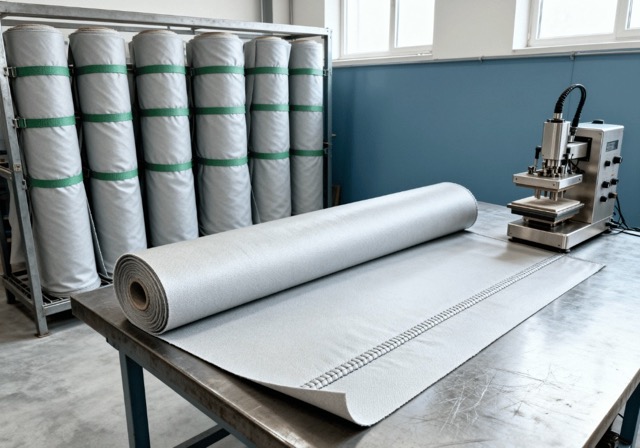
A heavy duty tarp is defined by a measurable spec set, and in the market the phrase starts to apply around 300 GSM fabric weight on a woven base cloth. Below that band, tarps cover pallets and garden equipment; above it, the same product family runs to industrial curtains and multi-season shelter roofs. This article reads the spec sheet along four dimensions: weight in GSM, base fabric denier and weave, coating route, and reinforcement hardware. Read those four lines and quotes from different suppliers become comparable on equal terms.
What Is a Heavy Duty Tarp?
A tarpaulin is a large sheet of waterproof-coated flexible fabric with reinforced edges and fixing points, tied down over whatever needs protection. Where the sheet effectively is the shelter, guidance on sustainable shelter construction from UNHCR treats covering material as a structural component, and industrial buyers apply the same logic to long-term covers. Terminology traces to the tent and awning vocabulary in ISO 7152. “Heavy duty” itself carries no legal definition, so a heavy duty tarp is only as defined as its four numbers: GSM, base fabric weave, coating, and reinforcement.
The Four Dimensions of a Heavy Duty Tarp
Weight, base fabric, coating, and reinforcement form one system. Each dimension moves the fabric up or down a duty class, and a quote that hides any of them is hard to evaluate. The subsections below put a number on each.
Weight: Reading Tarp GSM Tiers
GSM, grams per square meter, is the first number on nearly every quotation, and the market sorts heavy duty tarps into rough tiers around it.
| Weight class | GSM band | Typical duty |
|---|---|---|
| Light | 80-120 | Pallet covers, debris, short-season garden use |
| Standard | 150-250 | Firewood, machinery covers, event shade |
| Heavy duty | 300-600+ | Long-term covers, shelter roofs, truck curtains |
| High-spec PVC | 650-900 | Industrial containment, mining, semi-permanent structures |
Weight tracks durability, and it also tracks cost and handling weight, so the tier should match mission length. A GSM figure also blends base cloth and coating into one number, so two fabrics at the same weight can distribute it differently. Coating weight per side belongs on the same spec line as the total. Fabrics in the standard band suit rotational stock that deploys and recovers each season; SUNSHINE’s Heavy Strength Polyester 250D page shows a typical spec sheet for that tier. Agriculture and events fill the same band with hay covers, ground sheets under marquees, and windbreak walls.

Base Fabric: Denier and Weave Density
GSM says how heavy the fabric is; denier and weave density say where the strength comes from. Denier (D) measures yarn linear mass, so a 1000D yarn carries more abrasion and tear resistance than a light 150D weave at the same coating weight. Weave density, threads per unit width in warp and weft, controls how a point load spreads through the sheet. Weave and coating interact as well: a tight weave holds a thinner coating film, which keeps a heavy duty tarp supple in cold weather. SUNSHINE’s coated line runs 150D, 250D, 500D, 600D, and 1000D polyester, and the 1000D Polyester with PU Coating page lists the weave-and-coating detail that buyers should expect itemized on a heavy duty tarp quote.

Reinforcement: Grommets, Hems, and Corner Patches
Fabric rarely fails first; attachment points do. A tarp with grommets lives by its hardware: brass or steel eyes set at even spacing through a folded hem, with corner patches where a single point carries the whole load. Webbing handles along the edges give crews something to grip under tension. When comparing a tarp with grommets across suppliers, check spacing consistency, backing behind each eye, and whether the hem is stitched, welded, or both.
Reading the Performance Numbers
Tensile strength appears in newtons per 5 cm, quoted separately for warp and weft, under coated-fabric test methods such as ASTM D6614. Tear strength predicts how a small cut propagates once the fabric is nicked at a grommet. Waterproofness is quoted as a hydrostatic head, the water column pressure a coating resists, in line with coated-fabric water penetration methods such as ISO 22958. European buyers often work to EN equivalents, and the CEN standards search looks up the current document for any fabric property.
Anti-UV treatment and mildew resistance round out the sheet. Both matter for a heavy duty tarp that sits outdoors through a wet season, wrapped around equipment nobody checks weekly.
PE, PU, or PVC: Matching the Coating Route to the Mission
Three coating routes dominate the heavy duty tarp market, and the route decides service life as much as weight does.
| Route | Build | Weight feel | Strengths | Watch-outs | Typical duty |
|---|---|---|---|---|---|
| PE laminated | LDPE film on woven PE tape yarn | Lightest | Lowest cost per m², waterproof out of the pack | Shorter service life, hems typically stitched, faster UV aging | Temporary covers, relief distribution |
| PU coated polyester | PU coating on polyester base cloth | Light and supple | High strength-to-weight, folds without cracking, seams weldable | Cost above PE | Long-term covers, tent flies, shelter roofs |
| PVC coated polyester | PVC coating on polyester base cloth | Heaviest | Most durable, high-frequency weldable, resists weather and many chemicals | Bulk and weight; handling takes more crew | Industrial curtains, truck covers, long-exposure roofs |
A longer run at the PE and PVC trade-off, including service life, lives in the site’s PVC vs PE tents for storage: which lasts longer article. Mid-weight coated polyester such as the Ultra High Strength Polyester 500D line carries heavy duty tarps at lower handling weight than PVC, which matters where crews deploy covers by hand.

Heavy Duty Tarp Pitfalls at Procurement
Procurement failures cluster in the same places. A GSM figure quoted without denier or weave density is the classic: fabric can be heavy and still tear, because weight says nothing about yarn quality. Uneven grommet spacing shows up on site as ponding between fixing points, and eyes set without backing pull out under the first storm load.
Tensile quoted for one direction only hides a weak weft, so ask for warp and weft figures on the same sheet. Size tolerance is the quiet one: oversize panels join by welding, and the seam plan belongs on the drawing, in writing, before production starts. For EU-bound shipments, the European Commission’s CE marking portal explains how compliance duties split between manufacturer and importer; confirm that at the document stage, ahead of customs.
Fire codes change the fabric recipe. Flame-retardant grades such as M2 or B-s2,d0 are component-level fabric specifications, so name the grade in the order when a site code calls for one, and the coating package is built around it.
Heavy Duty Tarp Use Cases: Field Shelter to Industrial Cover
In humanitarian response, sheeting is a core relief item. The Global Shelter Cluster coordinates tarpaulins as standard non-food items in the first phase of a crisis, where light PE covers lead on airfreight weight. Semi-permanent camps shift the calculus toward coated polyester, which survives months of UV and welds into larger panels. Industrial sites buy from the heaviest band for machine covers, dust curtains, and containment, where PVC’s chemical resistance pays for the handling weight.
Logistics fleets specify the same heaviest band for truck side curtains, which see highway wind loads daily and still need to slide on rails. Warehouse and mining operators add conveyor covers and stockpile sheets, sized in panels and joined on site. To match a fabric band to a mission profile, the Shelter Mission Finder sorts deployment scenarios by duration and environment. SUNSHINE runs the coated polyester lines behind these use cases and welds panels to custom sizes for tarp and shelter makers.
FAQ
Does a higher GSM rating make a better heavy duty tarp?
Higher GSM adds mass, cost, and usually durability, yet the gain flattens when the base fabric is weak. A high GSM on loose tape yarn can tear below a lower-GSM, tightly woven polyester sheet. Match the tier to mission length; extra weight pays off when the cover stays out for seasons.
How do PE tarpaulin and PVC tarpaulin differ in service life?
PE tarpaulin wins on cost and packing weight, which suits short deployments and distribution. PVC tarpaulin lasts longer under continuous exposure, welds into seamless panels, and resists chemicals, which is why transport and industrial buyers pay the premium. The coating table above maps each route to its duty band.
What grommet spacing suits a tarp with grommets?
Even spacing matched to the frame or fixing points beats any universal number. Runs commonly land between half a meter and one meter on frames, closer at corners where load concentrates. Count fixing points per meter, and check the backing behind each eye, when comparing quotes.
Can a heavy duty tarp be made in custom sizes?
Yes, and welding keeps the seams clean. Coated polyester panels weld into larger sheets without stitch holes, so custom widths and lengths come off the line seam-sealed. Color, logo printing, and packaging are order-line options on the same fabric.
How should a heavy duty tarp be stored between seasons?
Clean off mud and organic debris, dry the sheet fully, and roll it instead of folding to avoid crease fatigue in the coating. Store it off concrete, away from UV and rodents. Stored dry and rolled, a heavy duty tarp redeploys without mildew or coating cracks at the next callout.