2026-10-13 SUNSHINE Engineering Team
Water Rescue Devices: Types and Selection Criteria

Water rescue devices fall into four functional groups: thrown, flotation, reach and lift, and powered. A team that fields all four keeps a response option when distance, current, or casualty condition takes the others off the table. Drowning kills an estimated 300,000 people each year, 92% of them in low- and middle-income countries, according to the World Health Organization. The sections below map each device type to its role, its rating standards, and its selection criteria. Those criteria decide what a crew can attempt in the first five minutes of a call.
What Are Water Rescue Devices?
A water rescue device is any piece of equipment that extends a rescuer’s reach, keeps a casualty afloat, or moves people across water during a rescue. The category covers far more than boats. A throw bag, a rescue board, a lifting bag, and a wearable flotation device all belong to it.
Standards bodies treat water rescue as a discipline with defined tiers. NFPA 1670 sorts water rescue operations into awareness, operations, and technician levels. Those tiers decide in practice which water rescue devices a team is trained to deploy. USCG boating accident statistics make the casualty-side case: drowning remains a leading cause of death in recreational boating, most often among people not wearing a life jacket. Equipment ratings and crew ratings advance together, and a team operates at the level of the lower one.
Four Types of Water Rescue Devices
The split below follows how teams deploy equipment: from shore, onto the casualty, by hand, or under power. Each group answers a different failure mode, so the groups complement one another and none replaces another. Where a SUNSHINE product illustrates a class, it is named as an example of the type.
Thrown Devices: Throw Bags and Ring Buoys
Throw bags are the shore-based first response in moving water. A rescuer braces, throws, and pays out line to a swimmer in the current. Bags commonly carry around 25 m of rope, enough to reach most channels a shore team works from.
The throw itself is a trained sequence. The swimmer catches the line, rolls onto their back, and the current swings them toward the bank while the rescuer belays from shore. Ring buoys fill the same role in flat water, at pools and docks, where a floating ring can be dropped beside a casualty from a fixed position.
For a throwable rescue device, the criteria are line length, rope diameter a gloved hand can grip, and a bag that drains and repacks in seconds. Most teams repack as part of every training session, because a badly stuffed bag is hard to place on target.
Flotation Devices: PFDs, Rescue Boards, and Stretchers
Flotation devices hold a casualty or a rescuer at the surface, and they carry the most mature rating system in the field. Personal flotation devices bear USCG approval labels referencing standards such as UL 1123, UL 1180, and 12402-5. The USCG PFD label gallery shows how each label reads. Rescue swimmers typically wear quick-release harness models so a tether can be cut loose when it snags.

A rescue board turns a swim into a paddle. The rescuer kneels or lies prone, reaches the casualty, and both have a stable object to hold while extraction is arranged. Inflatable models such as the SUNSHINE Inflatable Rescue Board pack into a vehicle and inflate in minutes, which suits teams that stage from the road. Boards fit flat water, flooded streets, and slow channels where paddling is a realistic approach.
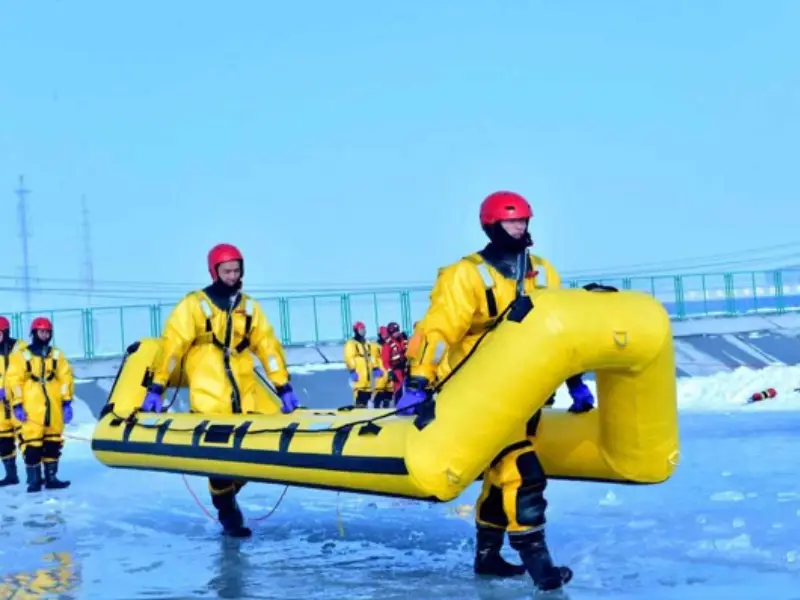
An injured casualty needs containment along with buoyancy. An inflatable rescue stretcher wraps the patient, floats the whole package, and tows or lifts into a boat; the Inflatable Rescue Stretchers page details the retention straps and grab points. Exhaustion, cold incapacitation, and suspected spinal injury all defeat simple towing, so teams treat the stretcher as the flotation device for anyone who cannot self-assist.

Reach and Lift Devices: Poles and Buoyancy Lift Bags
Reach tools close the final meters. A telescopic rescue pole extends a loop or hook to a casualty from a dock or bank, and in flat water it is often the fastest way to make contact. No entry, no tether, no second casualty.
Lift bags work below the surface. A Buoyancy Lift Bag System attaches to a submerged load, and controlled inflation adds enough displaced volume to raise a vehicle, right a capsized hull, or lift debris off a flooded entrance. Selection comes down to rated lift capacity, inflation method, and attachment points that spread load without tearing the target.

Powered Devices: Inflatable Rescue Boats
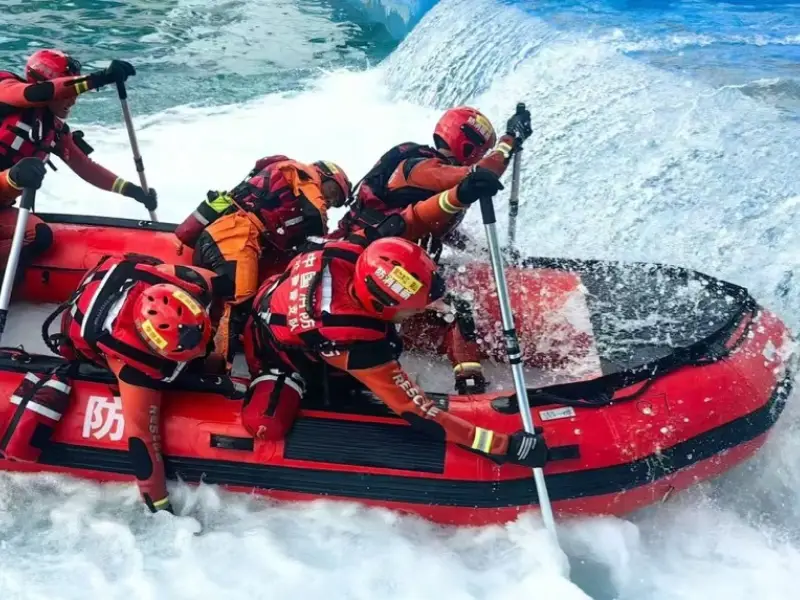
Powered craft carry crews and casualties across the water instead of reaching toward it. Inflatable rescue boats dominate flood and swiftwater response. They launch from ramps and shallows, shrug off contact with submerged objects, and carry a swimmer plus crew at once. Fabric is the component worth checking. ISO 15372 specifies requirements for the coated fabrics used in inflatable rescue boats; this material keeps the tubes airtight under abrasion and sun. SUNSHINE builds inflatable boats in the same product line as the boards and stretchers above; powered craft deserve their own treatment, so this article stays at device-class level.
Standards and Ratings Behind Water Rescue Equipment
Ratings tell you what a device was tested for, and personnel standards tell you who is qualified to use it. Both appear in procurement files, so reading them is part of comparing water rescue devices.
| Device group | Standard or framework | What it covers |
|---|---|---|
| Wearable PFDs | USCG approval with UL 1123, UL 1180, 12402-5 labels | Buoyancy, strength, and marking |
| Team operations | NFPA 1670 | Awareness, operations, and technician tiers for water response |
| Rescuer qualification | NFPA 1006 | Professional qualifications for technical rescue personnel |
| Lifeguard certification | ILSF certificate scheme | International certification, typically valid five years |
| Boat fabric | ISO 15372 | Coated fabric requirements for inflatable rescue boats |
| EU market access | CE marking | Manufacturer and importer compliance duties |
NFPA 1006 defines the professional qualifications individual rescuers hold at each level. The International Life Saving Federation publishes the certification scheme behind most lifeguard credentials, with certificates typically valid for five years before revalidation. Market access adds another layer: the European Commission’s CE marking portal explains how compliance duties split between manufacturer and importer for equipment sold in the EU.
The working rule is to buy water rescue equipment at the tier the team is certified to operate. A device list that outruns training creates exposure on the next audit and on the next callout alike.
Matching Water Rescue Devices to Water Conditions
Water grades run from Class I to Class VI, and the grade sets which device classes make sense to field. Read the table qualitatively; local hydraulics override any table.
| Water grade | Character | Device emphasis |
|---|---|---|
| Class I | Slow current, clear channels, easy self-rescue | Throw bags, ring buoys, standard PFDs, reach pole |
| Class II | Regular ripples, moderate maneuvering | Throw bags, rescue boards, rescue-grade PFDs |
| Class III | Irregular waves, stronger hydraulics, scouting advised | Boards plus bags, stretcher on standby, boat ready |
| Class IV to VI | Powerful, continuous, or unnavigable water | Powered craft, staged upstream teams, specialist training |
Criteria then follow in a fixed order. Water grade sets the device classes, and casualty profile refines the pick. A responsive swimmer takes a line, an exhausted or injured casualty takes a board or stretcher, and a submerged obstruction takes lift capacity. Distance from shore decides between thrown and carried devices. Staging decides how quickly each option comes into play.
A river callout shows the order in practice. Shore teams throw to the casualty while a board rescuer paddles from upstream; a stretcher waits at the eddy for the handoff; a boat stands ready at the ramp in case the casualty passes the reach line. Every device class has a position before the bag ever leaves the rescuer’s hand.
For a count-based starting point, the Rescue Team Configurator sizes an equipment set to team headcount and water grade. Mission-by-mission packing detail lives in the site’s Water Rescue Gear article, which works through water rescue equipment from the packing angle; the typology here stays one level above that.
FAQ
What is the difference between a throwable rescue device and a flotation device?
A throwable rescue device travels from rescuer to casualty through the air, so it works at a distance; throw bags and ring buoys are the common examples. A flotation device provides buoyancy at the casualty, such as a PFD, a rescue board, or a stretcher. Teams carry both, because distance and buoyancy fail under different conditions.
What does a minimum water rescue equipment set look like?
Baseline sets start at the water grade. Shore teams working Class I and II water typically run throw bags, ring buoys, a reach pole, and a PFD for every member. Class III and above adds boards, stretchers, boat capability, and technician-level training under NFPA 1670, and the set grows with each tier.
How do you read a USCG PFD label?
The approval label names the standard the vest was tested against, such as UL 1123, UL 1180, or 12402-5, and lists weight ranges and intended use. Matching the label to the water type matters more than matching it to a price. The USCG label gallery linked above shows samples of each format.
When does a team take a rescue board instead of a rescue stretcher?
Boards suit responsive casualties in flat or slow water, where the rescuer can paddle out and the casualty can hold on for the ride back. Stretchers suit casualties who cannot assist: injured, unconscious, or cold-incapacitated people need containment, and the stretcher gives them a towable, liftable package. Many teams stage both on the same vehicle.
How often should water rescue devices be inspected and replaced?
Inspect water rescue devices after every deployment and on a fixed calendar cycle between calls. Rope that has caught a full-body load goes on a retirement list in most team SOPs. Fabric items get checked for UV fading, mildew, and abrasion at each inspection. Log the checks, because renewals are easier to justify with an inspection history on file.