2026-09-09 SUNSHINE Engineering Team
Steel vs Aluminum Frame Tent: Weight, Cost, Wind
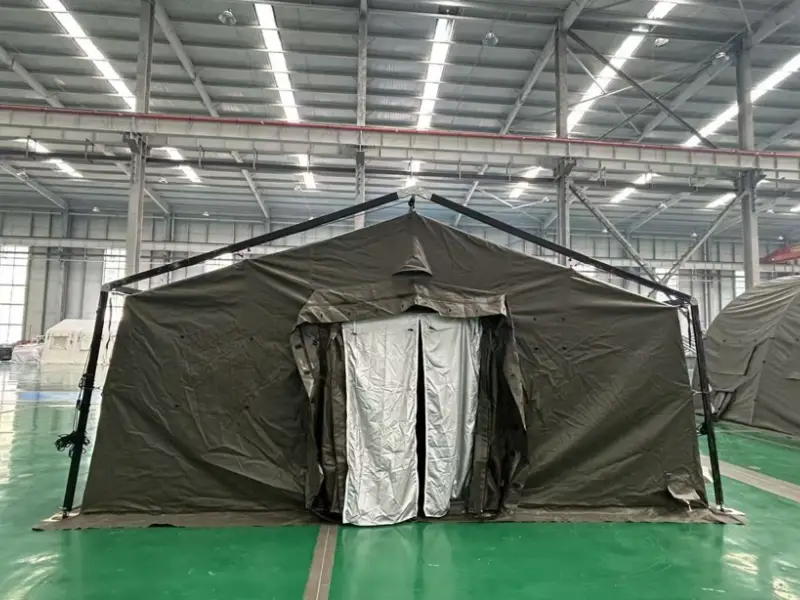
An aluminum frame tent suits programs that strike tents often, move them by truck or container, and work in coastal or humid climates. The frame weighs roughly one third as much as a steel frame of the same volume, and it does not rust. A steel frame tent suits semi-permanent installs where the frame rarely moves, spans run long, and upfront material cost matters more than crew time. Weight, corrosion, connection hardware, and wind documentation separate the two materials far more than price does. This comparison gives you the spec table, the cost structure, and a procurement checklist to score supplier bids side by side.
What Is a Frame-Supported Tent?
A frame-supported tent carries its membrane on rigid welded or bolted tubes. It needs no center poles and no ground guy lines for the main body. That is why relief agencies and industrial buyers put frame tents in parking lots, compound courtyards, and other tight sites where staking space does not exist.
The aluminum frame tent in one paragraph
An aluminum frame tent uses extruded aluminum tubes, typically 6061-T6 alloy, joined by cast or machined connectors. The alloy and temper matter as much as the tube diameter. A 6061-T6 beam delivers most of the strength at close to one third of the weight of an equivalent steel tube, according to The Aluminum Association. Aluminum also forms its own oxide layer. A scratched beam keeps its corrosion resistance without repainting, which is why aluminum framed kits survive coastal humidity and repeated truck loading with cosmetic rather than structural damage.
What counts as a steel frame tent
A steel frame tent uses rolled or welded carbon steel tubes, usually galvanized or powder coated against corrosion. Structural steel remains the reference material for long spans and heavy loads. That is why the American Institute of Steel Construction positions it for permanent and semi-permanent construction. In tent form, steel frames reach wider clear-spans at lower material cost. They also tolerate point loads, hung equipment, and forklift knocks better than aluminum. The tradeoff is mass: a steel frame can double the shipping weight of an equivalent aluminum kit. And once the galvanizing or coating is breached, rust moves fast in wet climates.
Key Points Before You Compare
| Decision factor | Favors aluminum | Favors steel |
|---|---|---|
| Strike and re-deploy frequency | Weekly or monthly moves | Install once per season or rarer |
| Transport | Truck and container weight limits | Weight budget is generous |
| Climate | Coastal, humid, salt exposure | Dry inland sites |
| Clear span | Up to roughly 30 m class frames | Wider spans, heavier loads |
| Upfront material cost | Higher per kilogram | Lower per kilogram |
| Crew and handling | Smaller crew, no crane | Crane or larger crew on big spans |
Aluminum Frame Tent vs Steel Frame Tent: Side-by-Side Specs
| Spec line | Aluminum frame | Steel frame |
|---|---|---|
| Frame weight per bay | Baseline (roughly one third of steel by volume) | About 3x aluminum for the same profile |
| Corrosion behavior | Self-passivating oxide; scratch safe | Galvanizing or coating dependent; rust after damage |
| Connection hardware | Cast or machined aluminum joints | Bolted plates, welded corners |
| Deflection under load | More elastic, flexes and returns | Stiffer, holds line under point loads |
| Field repair | Replace a beam, no welding | Weld or plate repairs need kit and skill |
| Typical spans in catalogue class | 10 to 30 m class | 20 to 50 m class |
| Freight class | Standard truck loadable | Often oversized per bay |
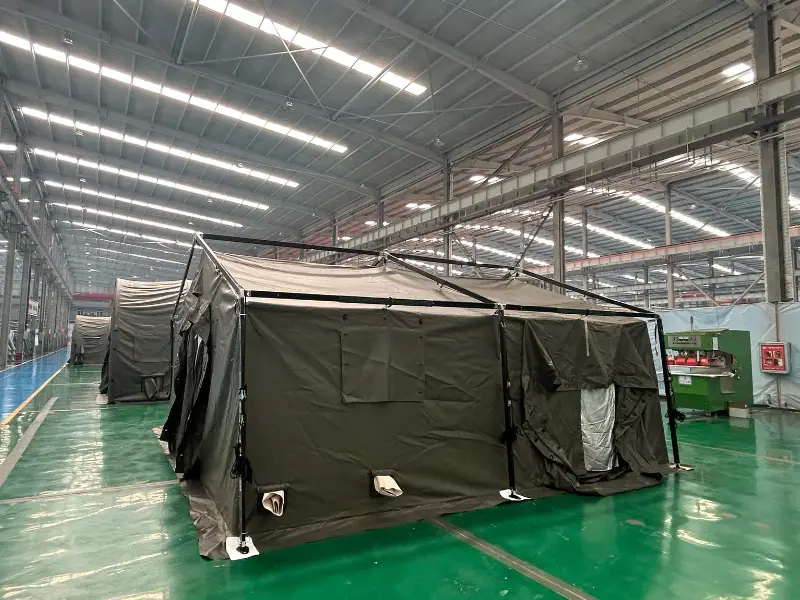
The numbers above are class descriptions rather than product claims, and your supplier drawings govern. When a bid lists a frame material without an alloy, temper, or wall thickness, treat the line as incomplete.
Aluminum frame tent weight in practice
Weight is where the comparison becomes concrete for logistics teams. A relief program moving framed shelters between four sites per season pays freight four times, and every kilogram of frame repeats in that bill. Lighter aluminum bays also change what carries them. A standard flatbed replaces a crane truck on most bays. A three-person crew replaces a five-person crew on strike. For buyers scoring quotes, ask each supplier for a packed weight per bay and a crew size per erection. Those two numbers expose the handling cost that the material price hides.
Cost Breakdown: Purchase Price vs Total Landed Cost
Steel tube costs less per kilogram at the mill, so a steel frame tent usually shows the lower purchase price on a like-for-like span. The aluminum frame tent price sits higher on the quote, and the comparison changes once freight and handling enter the calculation.
Three cost lines move the total. Freight rewards aluminum, because lighter bays fit a standard truck and cut fuel and escort costs on relief deployments. Handling rewards aluminum again, since a smaller crew strikes and redeploys without a crane. Crew days are a real budget line for agencies running rotating sites. Longevity rewards whichever material matches the site: a galvanized steel frame rusts quietly once coatings are breached in humid climates, while an aluminum frame’s oxide layer keeps protecting bare metal. European procurement files usually ask for CE-marked components under the applicable directives. Check which parts of the quote carry marking and which do not.
Where Each Frame Fits: Use Cases
Relief agencies working rotating sites tend to standardize on aluminum framed shelters because strike, truck, and re-erect cycles dominate the mission. Shelter speed matters most in the first phase of a disaster, when the IFRC describes shelter as one of the primary determinants of survival. The frame choice follows that reality. Speed of deployment outranks span records.
Steel frames fit the opposite profile. Storage halls, warehouse annexes, aircraft maintenance covers, and event venues installed for multi-year runs keep steel’s cost advantage and ignore its weight penalty, because nothing moves after commissioning. Military and logistics buyers sit in between, and many run both materials in one program. A semi-permanent base camp takes steel frames for kitchens, workshops, and warehouses where span and hung loads dominate. Forward teams that pack monthly take an aluminum frame tent instead, because pack size and truck count decide how far a deployment reaches on the same fleet.
Procurement Pitfalls
Watch for these failure points when you compare bids:
- Missing alloy and temper. A quote that says “aluminum frame” without 6061-T6 or equivalent lets the supplier substitute a softer alloy, and the frame behaves differently under wind load.
- Mixed metals in connections. Steel bolts on aluminum beams, or bare aluminum touching galvanized steel, sets up galvanic corrosion. The joint pays the price in wet climates. Ask which isolation washers or coated hardware the kit includes.
- Wind documentation. Serious suppliers publish wind ratings with the test basis or standard cited. European temporary structures work to EN 13782, the tent safety standard developed by CEN and CENELEC members, and a bid without a wind clause is a bid without a standard.
- Coating claims. “Galvanized” covers a range of coating weights. Ask for the class, and ask how cut edges and drilled holes are treated after fabrication.
- Anchor assumptions. Frame tents shed wind loads into anchors, not into mass. A frame swap changes anchor loads, so re-run the anchoring plan when you switch material.
- Spares and paperwork. Ask what spare connectors, feet, and beams ship with the frame, and whether erection drawings and a maintenance schedule come in the manual. A frame without documented spares costs more at year three than the quote shows.
FAQ
How long does an aluminum frame tent last outdoors?
A quality aluminum frame tent with 6061-T6 beams and proper connectors typically serves a decade or more outdoors. The oxide layer keeps protecting bare metal after scratches. Service life depends more on connection hardware, membrane care, and wind exposure than on the frame alloy itself.
Which frame handles wind better?
Neither material wins by default. Steel is stiffer and deflects less under gusts. Aluminum flexes and returns, which sheds energy but can loosen bolted joints over many cycles. The wind number that matters comes from the engineering documentation: anchoring loads, test basis, and the standard the design follows.
Is field repair harder on one material?
Steel repairs need welding equipment and a skilled hand, and a cracked weld in a remote site ends the season. Aluminum beam replacement is a spares-and-tools job: carry one spare beam per frame section and a crew can swap it in minutes.
Do standards differ between steel and aluminum frames?
The applicable tent safety standards treat the temporary structure, not the alloy. In Europe the relevant baseline is EN 13782 for temporary structures, and buyers in other regions should ask which national annex or test method the design references.
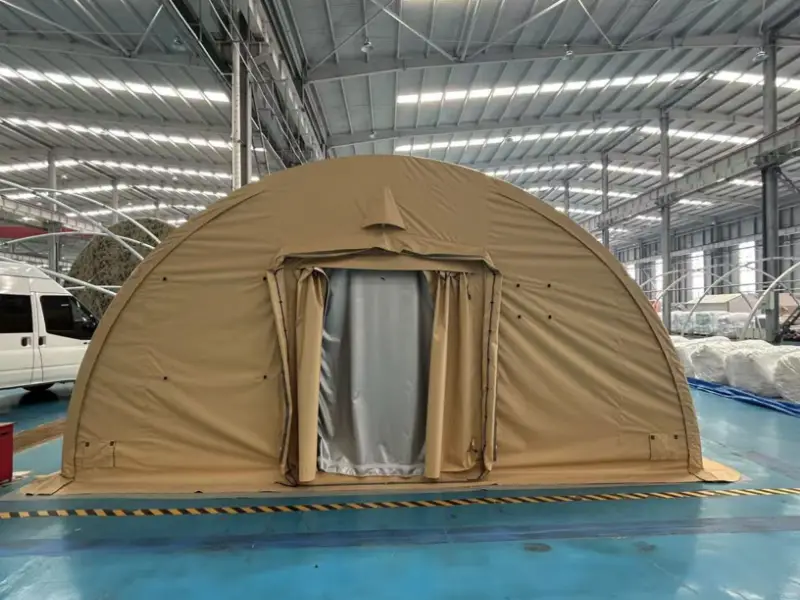
For rotating relief and response programs, the lower total cost usually sits with the aluminum frame tent once freight and crew days are counted, and the rust-free behavior pays back in coastal deployments. Compare the span, eave height, and packaging specs on the Rapid Deployment A-Frame and Arch product pages against your transport constraints, and run your mission profile through the Shelter Mission Finder to see which shelter class fits before you shortlist suppliers.
References
- CEN-CENELEC, European Committee for Standardization
- European Commission, CE marking
- The Aluminum Association
- American Institute of Steel Construction
- IFRC (International Federation of Red Cross and Red Crescent Societies)