
 View full image
 View full image
 View full image
 View full image
 View full image
 View full image
 View full image
Assisted-boarding rescue boat
Advanced Assisted-Boarding Rescue Boats — RSE Series
Inflatable rescue platform for flood, swift-water, offshore and complex emergency response.
Customizable to specification
- Models
- RSE385–RSE480
- Capacity
- Up to 10 persons
- Engine power
- Up to 40 hp
- Air chambers
- 4
Overview
The RSE Series is an advanced Assisted-Boarding inflatable rescue boat platform specially designed for flood rescue, swift-water rescue, offshore emergency response, and complex disaster environments.
Equipped with the innovative Breathable Air Chamber System, the RSE Series combines advanced maneuverability, adaptive buoyancy control, rescue flexibility, and operational stability into one professional rescue solution.
Designed for professional rescue teams, the RSE Series provides reliable performance in demanding water rescue missions where safety, precision, and efficiency are critical.
Key Features
Breathable Air Chamber System
Advanced Maneuverability
Stable Reverse Navigation Control
Anti-Backflow Drainage System
Rapid Deployment Capability
Excellent Low-Speed Stability
High-Strength Reinforced Hull Structure
Suitable for Flood & Swift Water Rescue
Flexible Rescue Operation Performance
Where the RSE Series fits in a rescue operation
Swift-water teams work bridges, weirs, and strainers where a casualty cannot climb into a hull unaided, the problem the assisted-boarding layout addresses. An RSE430 carrying 8 persons behind a 30 hp outboard holds station beside a fixed object while rescuers bring the casualty over the tube, with listed low-speed stability standing in for throttle work. Discipline context: our swift water rescue equipment guide.
Flood district evacuation is the second slot. Four air chambers on every model keep the hull usable after one compartment is damaged in debris, and the anti-backflow drainage system sheds water shipped during repeated boarding without letting it return through the same openings. Rapid deployment capability shortens arrival-to-first-run time, and fleet planning is covered in our flood boat walkthrough.
The marine and offshore tag points at man overboard recovery and standby duty around commercial vessels, where the wide RSE480 earns its place: a 196 cm beam, a 50 cm tube, and deck area for a recovered person, at 120 kg. Qualification references for this class of work include NFPA 1006, and the US Coast Guard accident statistics series tracks falls overboard as a standing category, the argument for staging dedicated recovery craft.
Interpreting the model range
The range runs RSE385, RSE430, and RSE480 at 380, 430, and 480 cm on a shared 176 cm beam, a 46 cm tube, and 4 air chambers throughout. Person ratings step 6, 8, then 10; hull weights rise 60, 65, to 75 kg. The engine column splits at 30 hp for the two shorter hulls and 40 hp for the RSE480, so the jump to a 10 person load coincides with the jump in power. RVC thickness stays a choice of 0.9 or 1.2 mm.
The table lists two RSE480 builds, and that split is the main selection decision in the series. The standard build is 480 by 176 cm with a 46 cm tube at 75 kg; the wide build is 480 by 196 cm with a 50 cm tube at 120 kg. Both hold 10 persons and take 40 hp, so the extra 45 kg buys deck area and tube volume, not capacity. Crews that hand-carry their boat stay with the lighter build.
Two feature names deserve a plain reading. The Breathable Air Chamber System is the listed buoyancy management feature, and stable reverse navigation control exists because assisted boarding often requires backing toward a casualty against the flow; neither appears as a number, so both deserve on-water trials.
Common questions from procurement teams
What separates the two RSE480 versions?
Beam, tube, and weight: 176 cm against 196 cm, a 46 cm tube against 50 cm, and 75 kg against 120 kg. Person capacity stays at 10 and the engine ceiling stays at 40 hp on both. Take the wide build when boarding dominates and launch support exists; take the lighter one when handlers move the boat by hand.
Is the series suitable for offshore standby duty?
The marine and offshore tag and the 40 hp ceiling fit standby and man overboard roles around vessels and platforms, where deck area and low-speed handling count. Sea-state acceptance for a specific station depends on the configuration, confirm with the engineering team.
What does the anti-backflow drainage system actually do?
It addresses the water shipped aboard while a casualty is brought over the tube in moving flow. The system drains that water and blocks return flow through the same openings, keeping the working deck usable during repeated boarding. That function defines the close-quarters boarding this class is built for.
Specifications
| Product | Advanced Assisted-Boarding Rescue Boats — RSE Series |
|---|---|
| Specification | Assisted-boarding rescue boat |
| Item No. | Size (cm, L × W) | Tube Diameter (cm) | Air chamber quantity | Max person capacity | Weight (kg) | Max Engine power (hp) | PVC thickness(mm) |
|---|---|---|---|---|---|---|---|
| RSE385 | 380 × 176 | 46 | 4 | 6 | 60 | 30 | 0.9/1.2 |
| RSE430 | 430 × 176 | 46 | 4 | 8 | 65 | 30 | 0.9/1.2 |
| RSE480 | 480 × 176 | 46 | 4 | 10 | 75 | 40 | 0.9/1.2 |
| RSE480 | 480 × 196 | 50 | 4 | 10 | 120 | 40 | 0.9/1.2 |
Applications
Customization
All specifications — including dimensions, materials, coating, colour, and accessories — can be tailored to your project requirements. Flexible MOQ from prototype to full-scale production; standard custom projects take 15–30 days from design confirmation to sample delivery.
Water Rescue Systems — common questions
Related products


Floating casualty stretcher
Inflatable Rescue Stretchers
Inflatable floating stretchers for casualty support and transfer in water-rescue operations.
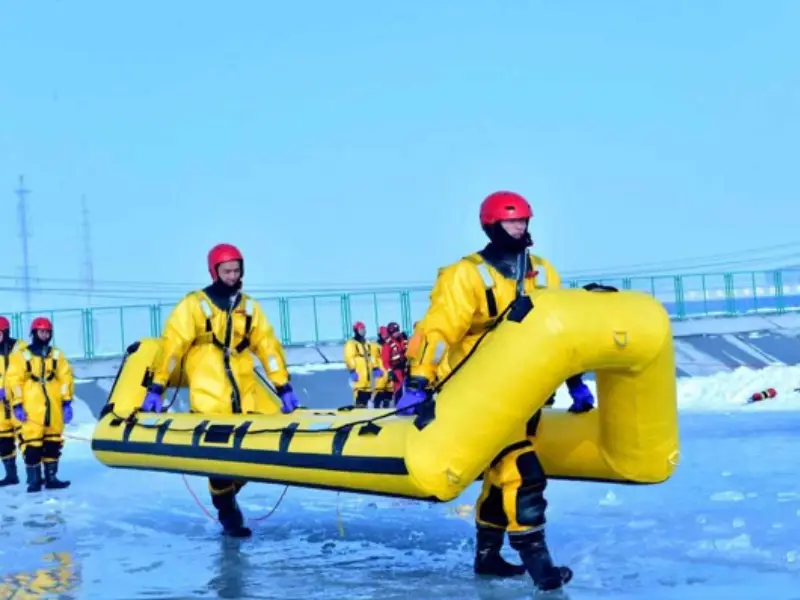
Winter water rescue craft
Inflatable Ice Rescue Boat
Inflatable rescue craft for fire brigades and response teams operating on ice and winter…